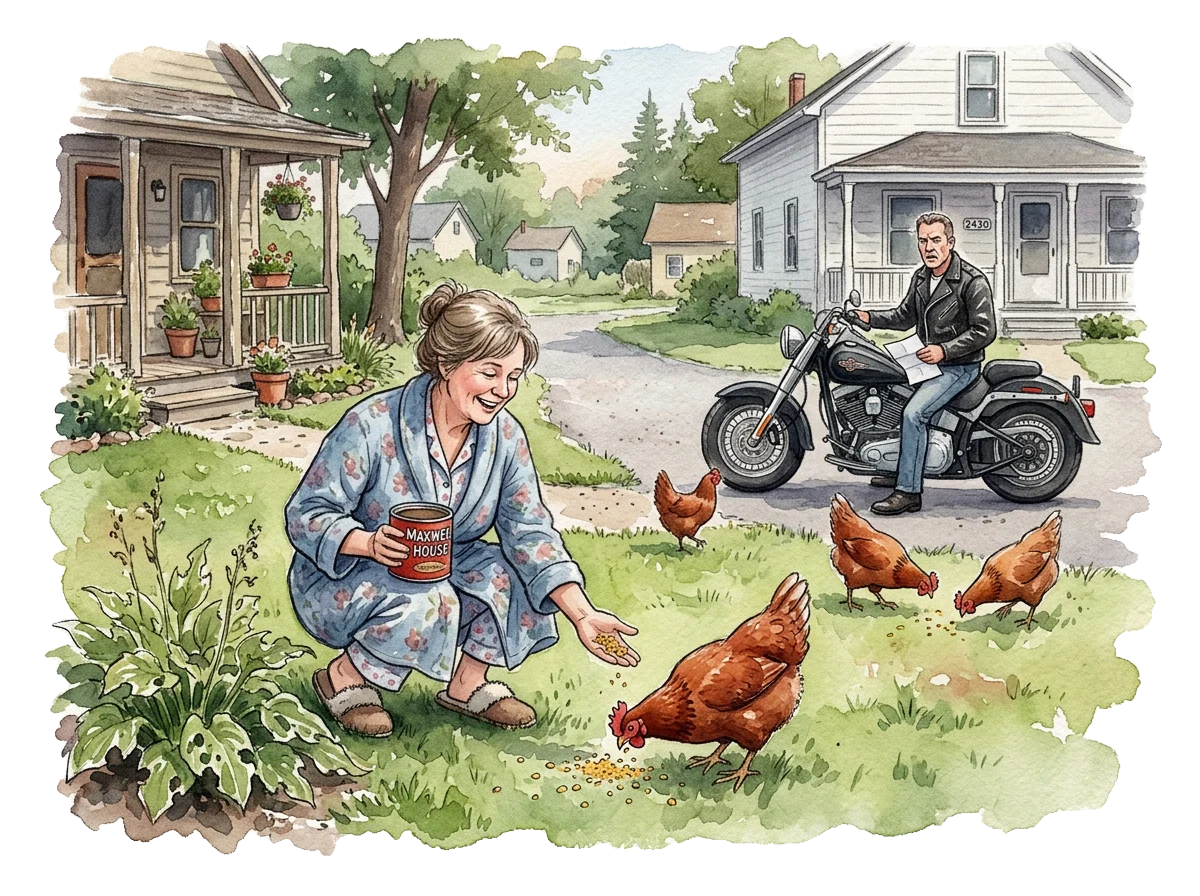
Chickens. Loud. Dirty. Foul.
Kornelius Friesen had been thinking those four words since April, when Lyle Brekke brought the chickens home. In June, when they started crossing into his yard, he wrote them at the top of a letter. Everything after them took eleven drafts. English was his third language and the least cooperative. Draft three went through Google Translate and back and came out accusing Lyle of “poultry crimes against my soul.” Draft seven quoted Minnesota Statute 561.09 and Exodus 22:5, both of which were on his side. It did not, however, quote Leviticus 19:18, which was not.
Draft eleven was calm, correct, and devastating. On a Saturday morning in August, he folded it into the pocket of his leather jacket and fired up the Fat Boy to ride across the road.
He was aware of the irony. The Harley was loud. It dripped on the garage floor. It had, if he was honest, a few foul habits of its own. But it was, as the men at the shop said, ‘murican, and so was he, and he had paid cash.
Lyle’s place was two hundred and forty feet from Kornelius’s mailbox. He had paced it. He could have walked it. But in the village where he grew up, five thousand miles from Pondview Lane, a man with a grievance did not walk. He arrived.
There, also, a chicken that crossed the road into another man’s yard was called stew. And Kornelius had been stewing over those chickens since April.
Here, it seemed, at least to Lyle, chickens had rights. Five Rhode Island Reds, red as a church carpet and about as reverent. Every morning they crossed the cul-de-sac at the end of Pondview Lane, just north of County 10, in the particular way chickens walk anywhere: hurried and distracted, prideful and skittish. Full of themselves. They walked like they had papers.
Then they spent the day dismantling his hostas and pooping on his yard, which was, he refused to admit, looking greener. He had chased them with a broom. He had chased them with a hose. Once, in a low moment he had not yet confessed even to God, he had chased them with the Fat Boy.
Lyle never said a word about any of it. Lyle waved. Every morning: Twins cap, end of the driveway, waving, like his chickens were not over there committing clucking crimes. Kornelius had lived in Minnesota nine years and still could not tell whether the friendliness here was a kindness or a way of slowly heaping coals onto his head.
Once he, his letter, and his Harley were on Lyle’s driveway, he revved the Fat Boy before killing the engine for effect. The silence was magnificent. He took out the letter.
“Korny?”
Not Lyle. His wife. Kornelius turned. Marlys was crouched at the edge of their own yard, across the road, in her bathrobe, half hidden by what was left of the hostas. She had a Folgers can in one hand. A hen was eating out of the other.
He looked at the can. He looked at the hen. He looked at Marlys.
She stood and held up the can a little sheepishly. Then she nodded at the hen. “This is why the chicken crossed the road.”
It had been since June. Cracked corn, every morning, after he left for the shop. She liked them, she said. They made little cooing noises when they saw her. It was endearing. Nothing else made little cooing noises for her.
Kornelius stood in Lyle’s driveway with the engine ticking and eleven drafts of righteous indignation slowly curdling in his hand.
Lyle came out onto the porch. He had a carton of eggs.
“Morning, Kornelius.” Lyle always said all four syllables. Nine years, and he had never once shortened it.
“Lyle.” Kornelius cleared his throat. “Lyle, I must tell you something about your chickens.”
“Marlys feeds ’em.” Lyle came down the steps. “Since about June.”
“You knew?”
“Saw her, maybe the second week or so.” He shrugged. “Figured she liked ’em.”
“I chased them with my motorcycle, Lyle.”
“Ya... I saw that too.”
“I have been telling the men at the shop that you are...” Kornelius stopped. He had been telling them several things, in three languages. “Why did you say nothing?”
Lyle thought about this the way Minnesotans think about everything, which is longer than seems necessary. “Wouldn’t’ve helped,” he said finally. “You’d have been mad at her instead of me. I can take it better.”
He held out the eggs.
Kornelius looked at them for a long moment. Then he put the letter back in his pocket and took them, because in no country on earth is there a dignified way to refuse eggs from a man you have misjudged.
“Thank you,” he said.
“You betcha.”
He set them in his lap and rode the two hundred and forty feet home very slowly. He already had egg on his face. He did not need it on his pants. That afternoon he picked up fifty pounds of cracked corn.
That night he burned the letter in the grill. Marlys asked what it was.
“Draft twelve,” he said.
Claughted by the numbers: the ideas were about two-fifths mine, and the words on the page closer to one-third. Call it 35% me. Everybody starts somewhere.